
The AI Edge: How Intelligent Tutoring Systems and Experiential Learning Are Cultivating Future-Ready Critical Thinkers
Education is no longer confined to the static pages of textbooks or the rigid structures of traditional classrooms. The digital transformation sweeping through the sector is not just about adopting new tools—it’s about reimagining how knowledge is acquired, applied, and mastered. At the heart of this evolution lies the powerful synergy between intelligent tutoring systems (ITS) and experiential learning, a combination that is equipping students with the critical thinking skills and adaptability needed to thrive in an increasingly complex world.
The Rise of Intelligent Tutoring Systems: Personalization at Scale
Intelligent tutoring systems are not merely digital versions of textbooks or automated quiz generators. These AI-driven platforms leverage machine learning and learning analytics to create dynamic, responsive learning environments that adapt in real-time to a student’s needs. Unlike traditional one-size-fits-all education models, ITS can identify knowledge gaps, adjust difficulty levels, and even predict where a learner might struggle next. This level of personalization was once the domain of elite private tutors, but AI is democratizing it, making high-quality, tailored education accessible to students regardless of their background or location.
For example, an ITS can analyze a student’s performance in a mathematics problem set and determine whether their errors stem from a misunderstanding of concepts, careless mistakes, or a lack of foundational knowledge. The system then tailors subsequent exercises to address these specific issues, ensuring that the student builds a robust understanding rather than merely memorizing procedures. This approach not only enhances learning outcomes but also fosters a growth mindset, as students see their progress in real-time and understand that intelligence is not fixed but developed through effort and strategy.
Experiential Learning: Bridging Theory and Practice
While intelligent tutoring systems excel at delivering personalized instruction, experiential learning takes education a step further by immersing students in hands-on, real-world applications of their knowledge. Rooted in the philosophy of educators like John Dewey and David Kolb, experiential learning emphasizes learning through doing, reflection, and iteration. It moves beyond passive absorption of information to active engagement, where students apply concepts in practical scenarios, test hypotheses, and learn from failure—a process that mirrors the iterative nature of innovation in the modern workforce.
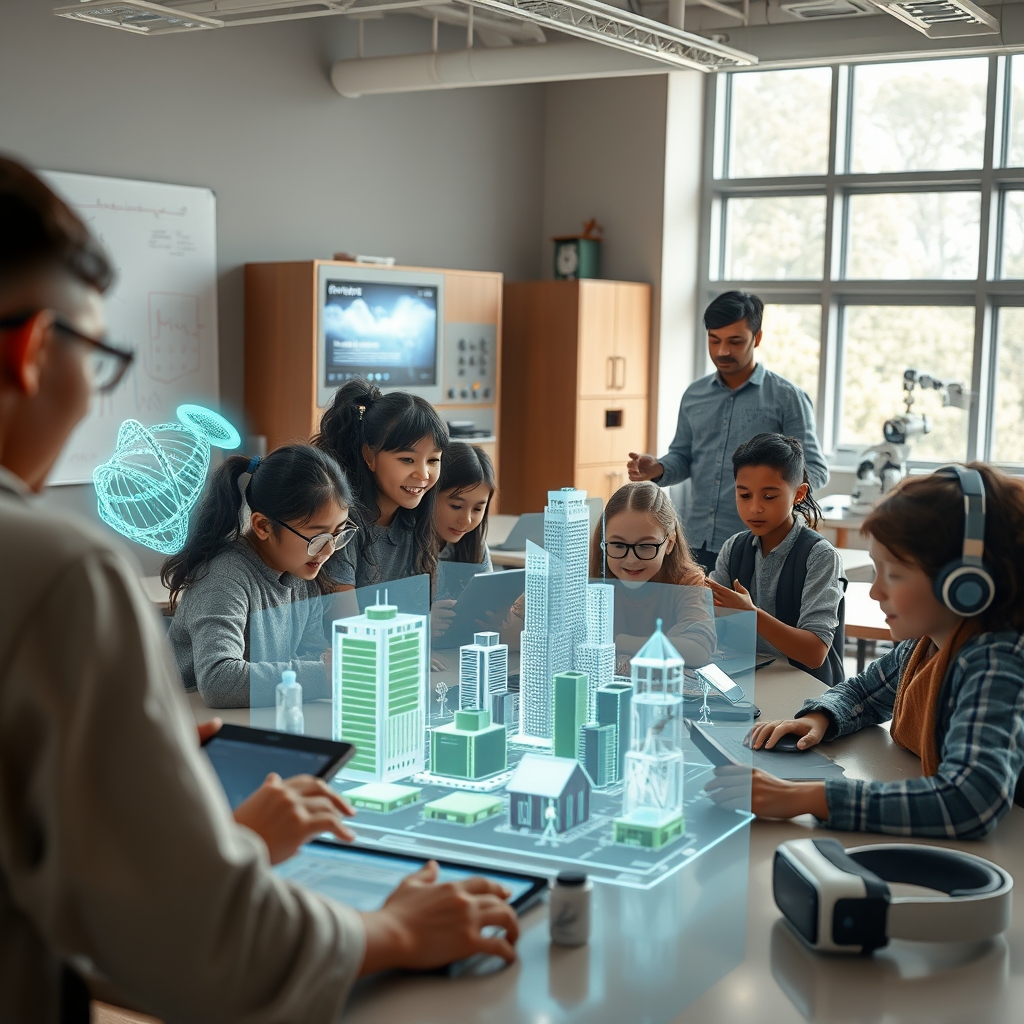
Consider a project-based learning (PBL) module in a STEM classroom. Instead of merely solving equations on paper, students might design a sustainable city, using principles of physics, engineering, and environmental science to address real-world challenges like energy consumption or waste management. Here, AI can play a supportive role by providing real-time feedback on their designs, simulating outcomes based on different variables, or even generating alternative solutions to inspire creative problem-solving. This fusion of AI and experiential learning transforms education from a theoretical exercise into a dynamic, interdisciplinary endeavor.
The Role of AI in Enhancing Experiential Learning
AI’s contribution to experiential learning extends beyond feedback and simulation. Generative tools, for instance, can create immersive scenarios that would be impossible or impractical to replicate in a physical classroom. Virtual labs powered by AI allow students to conduct experiments in chemistry or biology without the constraints of time, cost, or safety concerns. Similarly, AI-driven role-playing simulations can place students in historical events, ethical dilemmas, or complex negotiations, forcing them to think critically, make decisions, and witness the consequences of their actions in a risk-free environment.
Moreover, AI can facilitate collaborative learning by matching students with peers who have complementary skills or perspectives, fostering teamwork and communication. In a globalized world where interdisciplinary collaboration is the norm, these experiences are invaluable. They teach students not only how to work with others but also how to leverage diverse viewpoints to solve problems—a skill that is increasingly critical in fields ranging from engineering to public policy.
Cultivating Critical Thinkers for an Uncertain Future
The ultimate goal of education is not to fill students’ minds with facts but to equip them with the tools to navigate an unpredictable future. Critical thinking—the ability to analyze information, evaluate arguments, and synthesize knowledge—is the cornerstone of this preparedness. However, developing these skills requires more than rote memorization or standardized testing. It demands environments where students are encouraged to question, experiment, and reflect.
Intelligent tutoring systems and experiential learning create precisely these kinds of environments. By combining the precision of AI-driven personalization with the depth of hands-on experience, educators can cultivate learners who are not only knowledgeable but also adaptable, creative, and resilient. For instance, an ITS might help a student master the fundamentals of computer science, while a project-based module challenges them to develop an app that addresses a social issue in their community. The result is a student who understands both the technical and human dimensions of their work, a combination that is essential for tackling the multifaceted challenges of the 21st century.
Addressing Educational Equity Through AI and Experiential Learning
One of the most promising aspects of this synergy is its potential to advance educational equity. Traditional education systems often perpetuate disparities by relying on resources that are unevenly distributed—access to experienced teachers, advanced coursework, or extracurricular opportunities. AI and experiential learning, however, can level the playing field by providing high-quality, scalable solutions that reach students in underserved communities. For example, an ITS can deliver personalized instruction to a student in a rural school just as effectively as it can to a student in an urban private institution. Similarly, virtual experiential learning modules can bring global perspectives and real-world challenges to classrooms that lack the resources for field trips or guest speakers.
Of course, technology alone cannot solve the deep-rooted issues of inequity in education. It must be paired with thoughtful implementation, teacher training, and policies that ensure access and inclusion. Yet, when used intentionally, AI and experiential learning can dismantle barriers and create opportunities for all students to develop the critical thinking skills they need to succeed.
As we stand on the brink of a new era in education, the fusion of intelligent tutoring systems and experiential learning offers a glimpse into a future where every student is empowered to think deeply, learn actively, and contribute meaningfully. The tools are here, the potential is vast, and the need has never been greater. The question is no longer whether we can transform education but how quickly we can make this vision a reality for learners everywhere.



