
The Synergy of AI and Experiential Learning: Crafting Immersive Educational Experiences for the 21st Century
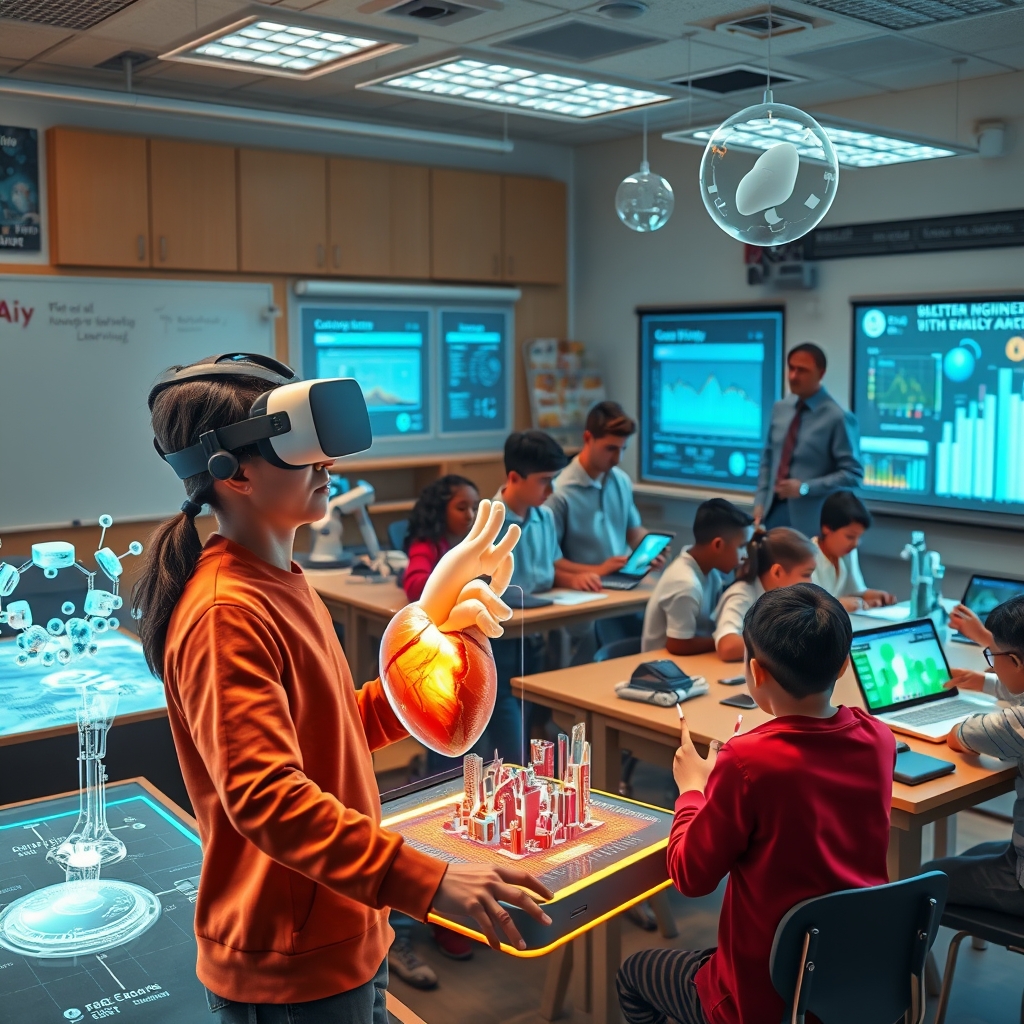
In an era where technology permeates every facet of our lives, education stands at the precipice of a transformative shift. The fusion of artificial intelligence (AI) and experiential learning is not just redefining how students engage with content but is also reshaping the very essence of what it means to learn. This evolution is particularly profound in fields like Science, Technology, Engineering, and Mathematics (STEM), where traditional pedagogical approaches often struggle to keep pace with the rapid advancements in knowledge and the demands of a dynamic workforce. By leveraging AI, educators can create immersive, hands-on learning experiences that foster deep understanding, critical thinking, and a lifelong passion for discovery.
The Evolution of Experiential Learning
Experiential learning, a concept rooted in the theories of educational pioneers like John Dewey and David Kolb, emphasizes learning through reflection on doing. It moves beyond rote memorization and passive absorption of information, instead encouraging students to actively engage with material, experiment, and apply knowledge in real-world contexts. Historically, this approach has been constrained by logistical challenges—limited resources, time, and the difficulty of tailoring experiences to individual learners. However, AI is dismantling these barriers, enabling scalable, personalized, and deeply engaging experiential learning opportunities.
AI as the Catalyst for Personalization
One of the most significant contributions of AI to experiential learning is its ability to personalize educational journeys. Traditional classrooms often adopt a one-size-fits-all model, where the pace and depth of learning are dictated by the average student. AI disrupts this paradigm by analyzing vast amounts of data—from student performance to engagement patterns—to create adaptive learning pathways. For instance, an AI-driven platform can identify when a student is struggling with a particular concept in a STEM subject and dynamically adjust the difficulty of experiments or simulations to match their proficiency level. This ensures that learners are neither bored by material that is too easy nor overwhelmed by content that is too advanced.
Moreover, AI can curate bespoke learning experiences by integrating interdisciplinary content. A student exploring the physics of renewable energy, for example, might be guided through a virtual lab where they design wind turbines, while simultaneously receiving insights into the environmental and economic implications of their designs. This holistic approach not only deepens understanding but also cultivates the kind of critical thinking and problem-solving skills that are essential in the modern world.
The Role of Generative Tools in Immersive Learning
Generative AI tools are pushing the boundaries of what is possible in experiential learning. These tools, which can create text, images, code, and even simulations, are enabling educators to design rich, interactive environments that were once the stuff of science fiction. Imagine a biology class where students use AI-generated 3D models to dissect virtual organisms, exploring anatomy in ways that are not only more accessible but also more ethical and sustainable than traditional methods. Or consider a history lesson where AI generates immersive, historically accurate scenarios, allowing students to “live” through pivotal moments in time, making decisions that shape the outcome of events.
Simulations and Virtual Reality: The New Frontier
The integration of AI with virtual reality (VR) and augmented reality (AR) is taking experiential learning to new heights. These technologies create safe, controlled environments where students can practice skills, conduct experiments, and explore complex concepts without the risks or costs associated with real-world scenarios. For example, medical students can perform virtual surgeries, receiving real-time feedback from AI on their technique and decision-making. Similarly, engineering students can design and test prototypes in a virtual space, iterating on their designs based on AI-driven analytics that predict performance under various conditions.
These simulations are not just about replicating real-world experiences; they are about enhancing them. AI can introduce variables and scenarios that would be impossible or impractical to recreate in a physical setting. A chemistry student, for instance, might explore the behavior of molecules under extreme conditions, or a physics student could simulate the effects of zero gravity on different materials. Such experiences not only make learning more engaging but also prepare students for the kinds of challenges they will face in their future careers.
Bridging Gaps with Inclusive and Equitable Design
While the potential of AI and experiential learning is vast, it is crucial to ensure that these advancements are accessible to all students, regardless of their background or abilities. Educational equity must be at the forefront of this digital transformation. AI can play a pivotal role in creating inclusive learning experiences by adapting content to meet the diverse needs of learners. For example, AI-powered tools can provide real-time translations, generate alternative text for visual content, or adjust the complexity of language to suit different reading levels. These features make learning more accessible to students with disabilities, non-native speakers, and those from underrepresented communities.
The Importance of Digital Literacy
As AI becomes more integrated into education, digital literacy is no longer a luxury but a necessity. Students must be equipped with the skills to navigate, evaluate, and leverage digital tools effectively. This includes understanding how AI works, recognizing its limitations, and using it ethically. Educators play a critical role in fostering digital literacy by incorporating it into the curriculum and modeling best practices. For instance, a project-based learning activity might require students to use AI tools to gather and analyze data, while also reflecting on the ethical implications of their use. By doing so, students not only develop technical skills but also cultivate a critical mindset that will serve them well in an increasingly digital world.
The Future of Lifelong Learning
The synergy between AI and experiential learning is not just transforming K-12 and higher education; it is redefining lifelong learning. In a world where knowledge is constantly evolving, the ability to learn continuously is more important than ever. AI-driven platforms can provide personalized, on-demand learning experiences that adapt to the changing needs of professionals. For example, an engineer looking to upskill in renewable energy technologies might engage in AI-curated microlearning modules, complete with interactive simulations and real-world case studies. These platforms can also offer gamified learning experiences, where professionals earn badges or certifications for completing challenges, making the process of continuous learning both engaging and rewarding.
As we look to the future, the fusion of AI and experiential learning holds the promise of creating educational experiences that are not only more effective but also more human. By placing students at the center of their learning journeys, these technologies empower them to explore, experiment, and discover in ways that were once unimaginable. The classroom of tomorrow will not be confined by walls or limited by resources; it will be a dynamic, ever-evolving space where curiosity is nurtured, and potential is unlocked. In this new era, education will not just be about acquiring knowledge but about cultivating the skills, mindset, and resilience needed to thrive in an uncertain and rapidly changing world.



