
The AI Learning Kaleidoscope: How Generative Tools and Critical Thinking Are Crafting Dynamic, Equity-Driven Pathways for Interdisciplinary Mastery
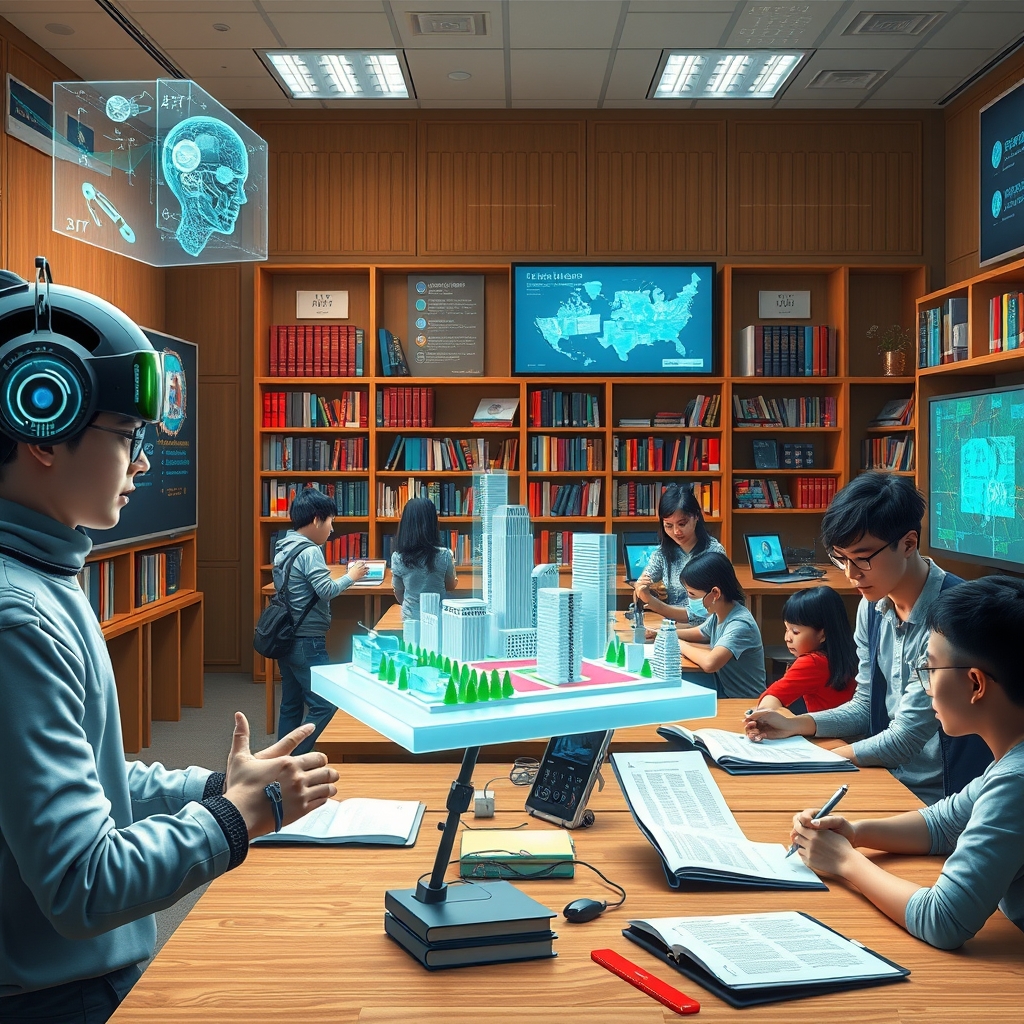
Imagine a classroom where every student’s unique strengths, curiosities, and learning pace are not just acknowledged but celebrated—where the boundaries between subjects dissolve, and education becomes a vibrant, ever-evolving tapestry of ideas. This is not a distant utopian vision but a rapidly unfolding reality, thanks to the convergence of artificial intelligence and innovative pedagogical approaches. At the heart of this transformation lies a powerful synergy: generative tools that adapt to individual needs and critical thinking frameworks that empower learners to navigate complexity with confidence. Together, they are redefining what it means to master knowledge in the 21st century.
The Generative Revolution: Personalization at Scale
Generative AI is not merely a tool for automating tasks; it is a catalyst for reimagining how education is delivered. Unlike traditional one-size-fits-all models, generative systems analyze vast amounts of data to create dynamic, personalized learning experiences. For instance, an AI-driven platform can generate tailored reading materials, quizzes, or even interactive simulations that align with a student’s current understanding and interests. This level of customization was once the domain of elite tutoring, but AI is democratizing it, making high-quality, adaptive education accessible to learners regardless of their background or location.
Consider a high school student struggling with algebraic concepts. Instead of relying on static textbooks or generic video lectures, an AI-powered tutor could generate a series of problems that gradually increase in difficulty, interspersed with real-world examples that resonate with the student’s hobbies—whether that’s sports statistics, music theory, or environmental science. The system doesn’t just provide answers; it scaffolds the learning process, offering hints and explanations that evolve based on the student’s responses. This is the essence of personalized learning: a fluid, responsive approach that meets learners where they are and guides them forward.
Breaking Down Silos: The Rise of Interdisciplinary Learning
The rigid divisions between academic disciplines are increasingly at odds with the interconnected nature of the modern world. Problems like climate change, global health, and technological ethics demand solutions that draw from multiple fields—science, humanities, social sciences, and the arts. AI is uniquely positioned to facilitate this shift toward interdisciplinary learning by curating content, generating cross-disciplinary projects, and even simulating complex scenarios that require multifaceted thinking.
Take, for example, a project-based learning module on sustainable urban development. An AI system could generate a scenario where students must design a eco-friendly neighborhood, incorporating elements of engineering, economics, sociology, and environmental science. The AI could provide real-time feedback on their proposals, suggest relevant case studies from around the world, or even simulate the long-term impact of their decisions. By blending experiential learning with interdisciplinary exploration, students are not just memorizing facts; they are developing the ability to synthesize knowledge and apply it to real-world challenges.
The Role of Critical Thinking in an AI-Augmented World
As AI takes on a more prominent role in education, the importance of critical thinking cannot be overstated. Generative tools are incredibly powerful, but they are not infallible. They can produce biased, inaccurate, or overly simplistic outputs if not guided by human discernment. This is where critical thinking becomes the linchpin of effective learning. Students must learn to question, evaluate, and contextualize the information generated by AI, ensuring that they are not passive consumers of content but active, discerning participants in their own education.
Educators are increasingly integrating critical thinking frameworks into AI-driven lessons. For example, a history class might use AI to generate alternative perspectives on a historical event, then task students with analyzing the biases, evidence, and logical consistency of each account. Similarly, a science class could use AI to simulate experimental data, prompting students to design their own experiments to verify or challenge the results. These exercises cultivate a mindset of inquiry and skepticism, equipping students with the skills to navigate an information-rich world where truth is often obscured by noise.
Equity Through Adaptive Access
One of the most profound promises of AI in education is its potential to bridge gaps in educational equity. Traditional classrooms often struggle to accommodate the diverse needs of students, particularly those with learning disabilities, language barriers, or socioeconomic challenges. AI-powered tools can level the playing field by providing adaptive resources that cater to individual needs. For instance, text-to-speech and speech-to-text functionalities can support students with dyslexia or visual impairments, while real-time translation tools can break down language barriers for non-native speakers.
Moreover, AI can help identify and address systemic inequities in education. Learning analytics—powered by AI—can track patterns in student performance, revealing disparities in access to resources or opportunities. Schools can then use this data to allocate support where it’s needed most, whether that’s additional tutoring, mentorship programs, or targeted interventions. By making education more inclusive, AI is not just improving outcomes for individual students; it is fostering a more just and equitable society.
The Human Element: AI as a Collaborator, Not a Replacement
Despite the transformative potential of AI, it is essential to remember that technology is a tool, not a replacement for human connection. The most effective learning experiences are those that blend AI’s capabilities with the empathy, creativity, and intuition of educators. Teachers remain the architects of learning environments, using AI to enhance their ability to inspire, mentor, and challenge students. For example, an AI system might handle the administrative tasks of grading or lesson planning, freeing up teachers to focus on what they do best: building relationships, fostering curiosity, and guiding students through the complexities of learning.
This collaborative approach also extends to students. AI can serve as a co-creator in the learning process, helping students brainstorm ideas, refine their work, or explore new concepts. In a writing class, for instance, an AI tool might generate multiple drafts of an essay based on a student’s outline, allowing the student to compare and contrast different approaches. The student then becomes the editor, using their critical thinking skills to select, revise, and polish the final product. In this way, AI empowers students to take ownership of their learning, transforming them from passive recipients of knowledge into active creators.
The Future of Learning: A Dynamic, Ever-Evolving Journey
The integration of AI into education is not a destination but a continuous journey of exploration and refinement. As generative tools become more sophisticated and learning analytics more nuanced, the possibilities for personalized, interdisciplinary, and equitable education will only expand. Yet, the true measure of success will not be the technology itself but the ways in which it enhances the human experience of learning. In classrooms where AI and critical thinking intersect, students are not just preparing for the future; they are shaping it, one adaptive, experiential, and inclusive lesson at a time.
The kaleidoscope of AI-driven education is still unfolding, its patterns shifting with each new innovation and insight. What remains constant is the vision of a learning ecosystem where every student has the opportunity to thrive, where curiosity is nurtured, and where the boundaries of what is possible are continually redefined. In this dynamic landscape, the most valuable skill is not mastery of any single subject but the ability to adapt, question, and grow—a skill that AI, at its best, is uniquely positioned to cultivate.



